
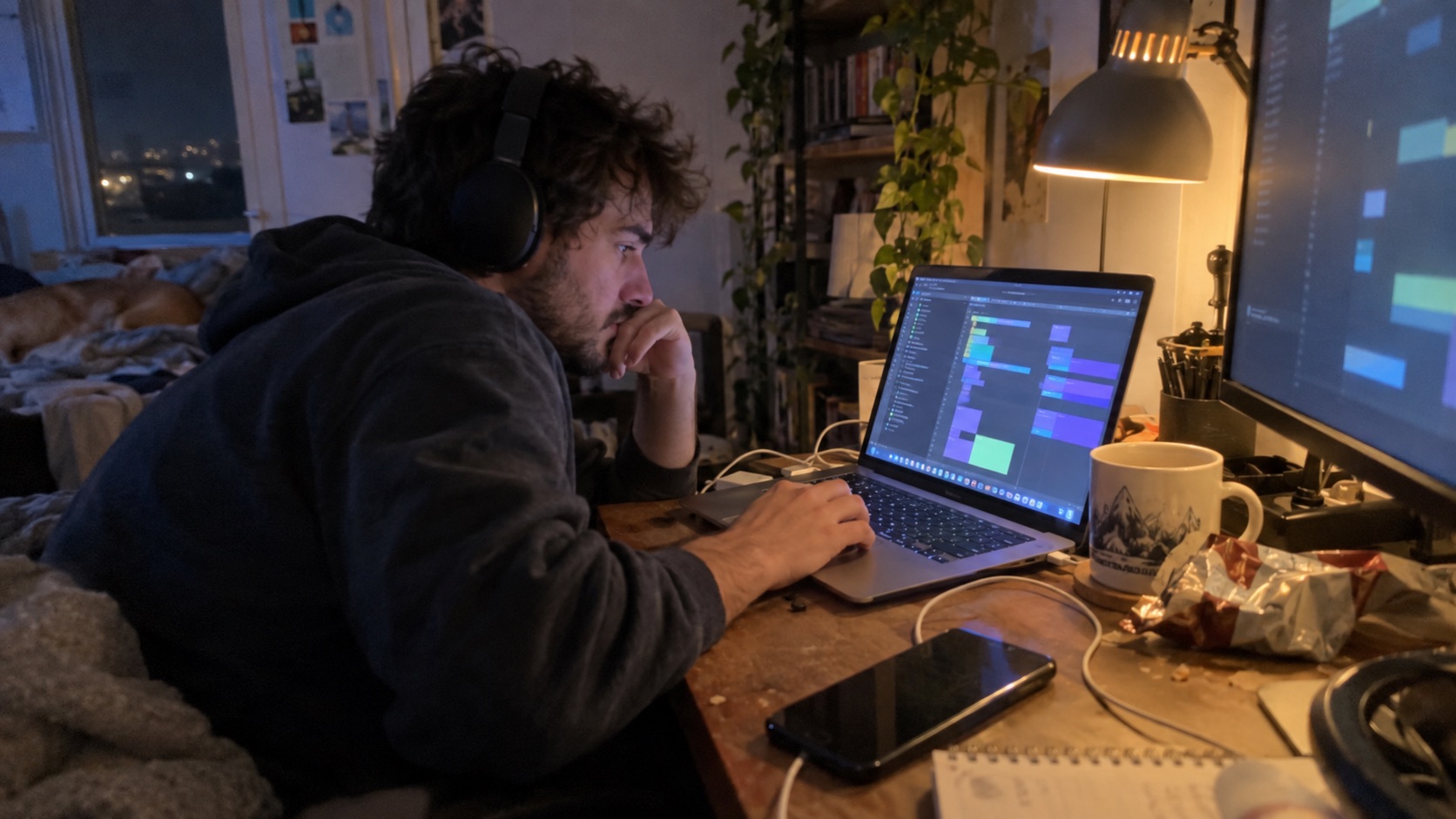
Vibe coding is an informal name for building software by describing desired changes to an AI and judging the running result, often without reading or writing much of the underlying code.
It makes software creation more accessible and dramatically speeds up exploration. It also changes where the hard work lives: from typing syntax toward defining intent, reviewing behavior, and managing risk.
What the workflow looks like
A typical loop is:
- Describe an app or change in natural language.
- Let an AI agent generate or edit code.
- Run the product and inspect the result.
- Give corrective feedback.
- Repeat until the experience feels right.
This is especially effective for prototypes, internal tools, familiar CRUD workflows, design exploration, and small utilities. The feedback loop is visual and immediate.
Why it feels different
Traditional development requires translating intent into programming languages and frameworks. Vibe coding delegates much of that translation. A person can stay closer to the problem and interact with the implementation through outcomes.
The tradeoff is hidden complexity. The app may look correct while authorization, error handling, data migration, accessibility, or performance remains wrong.
Where vibe coding works well
- Exploring whether an interaction is useful.
- Producing a disposable prototype.
- Automating a personal or team workflow.
- Building standard interfaces around known data.
- Giving an experienced developer a faster implementation loop.
The common feature is bounded risk and fast feedback.
Where extra care is required
Use stronger review for payments, health or financial data, public authentication, multi-tenant permissions, safety-critical behavior, regulated workflows, and high-scale systems.
The concern is not that AI wrote the code. The concern is whether anyone can explain and verify the system’s important properties.
From vibe to reliable product
You do not need to abandon prompt-led development. Add discipline as the product becomes real:
- Keep the project in version control.
- Ask for a plan and explicit assumptions.
- Define acceptance criteria for important changes.
- Run automated checks and inspect what they prove.
- Test authorization and data boundaries independently.
- Use separate development and production environments.
- Review dependencies, secrets, privacy, and recovery.
- Preserve a rollback path.
Treat AI output like a fast contribution from a collaborator: useful, reviewable, and never automatically correct.
Is vibe coding no-code?
Not exactly. No-code platforms constrain creation to visual modules and a platform runtime. Vibe coding commonly generates conventional code through natural language. The creator may avoid direct coding, but the resulting system can still contain a normal codebase.
Frequently asked questions
Who coined vibe coding?
The phrase became popular as a casual description of accepting AI-generated changes based mainly on whether the result works and feels right. Its practical meaning varies, so define the workflow rather than arguing over a strict category.
Can non-developers use vibe coding?
Yes, especially for prototypes and bounded tools. As consequence and complexity increase, involve someone who can evaluate architecture, security, and operations, or use a managed system that takes responsibility for those layers.
Is vibe coding production ready?
It is a method, not a quality certification. Production readiness depends on the resulting product, tests, security, reliability, deployment, and ownership.
For a more structured workflow, read how to build an app with AI.