An app idea becomes a product when someone can use it to achieve a result. The work between those points is less about protecting the idea and more about removing uncertainty.
1. Name one user and one moment
Replace “an app for travelers” with a specific situation such as “a group organizer trying to collect arrival details before a trip.” Precision helps you find interviewees, choose features, and write useful copy.
2. Study the current workaround
Interview potential users about the last real occurrence. Look for spreadsheets, group chats, repeated messages, manual reconciliation, abandoned purchases, or paid tools. A workaround reveals both demand and competing behavior.
3. Write the value hypothesis
Use a falsifiable sentence: “For [user], the product makes [job] easier by [mechanism], resulting in [observable outcome].” Avoid claims you cannot measure.
4. Map assumptions by risk
List what must be true about demand, usability, technology, distribution, compliance, and economics. Test the assumption that could invalidate the product first. A beautiful interface cannot rescue missing demand or an impossible integration.
5. Test demand cheaply
Use a landing page, manual service, waitlist, prototype, or paid pilot. Decide in advance what evidence would change your mind. Email signups can show interest; payment or repeated use is stronger evidence.
6. Define the smallest complete journey
Describe how a new user reaches the first valuable outcome. Cut features that do not support this journey, safety, or learning. Keep a later list so cutting scope does not feel like losing the idea.
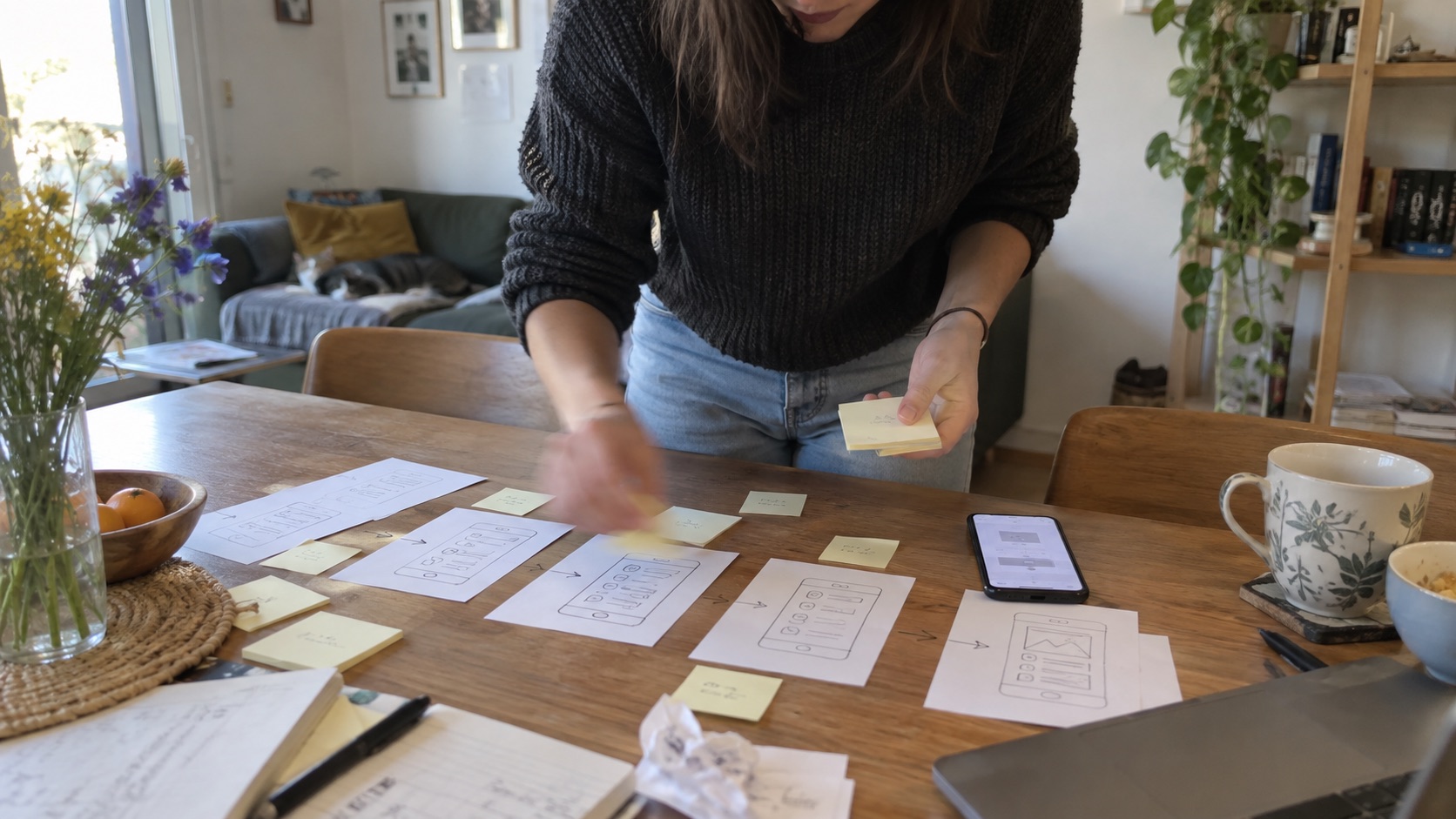
7. Prototype the risky interaction
Test navigation and language with realistic content. If the technical risk is more important, live location, media processing, payments, or an unusual integration, build a technical proof before polishing screens.
8. Choose the build route
Compare AI builders, no-code platforms, cross-platform development, native development, and a hired team against the hardest requirement. Consider ownership, integrations, store delivery, ongoing changes, and operational support, not just initial speed.
9. Build, instrument, and test
Build one vertical slice and add analytics around outcomes. Test failures as deliberately as success: denied permissions, empty states, expired sessions, poor networks, duplicate actions, and invalid data.
10. Launch as another experiment
Release to the audience that shaped the problem. Watch activation and repeat use, collect support conversations, and fix blockers. The first launch is the beginning of evidence, not the end of development.
Protect the product, not just the idea
Keep written agreements with collaborators. Control the domain, repositories, store accounts, data, and billing. Use appropriate confidentiality and intellectual-property advice when real commercial or legal risk exists, but do not let secrecy prevent customer learning.
Frequently asked questions
Do I need a business plan first?
You need a clear problem, audience, evidence plan, rough economics, and delivery path. A long formal plan is useful only if a stakeholder or financing process requires it.
Should I find a developer or validate first?
Validate the problem before funding a large build. A developer can help test technical feasibility early, especially when the product depends on an unusual integration.
What should I build first?
Build the smallest complete journey that tests your most important assumption. Use the broader app creation guide to plan what follows.
Describe your idea to GrowApps when you are ready to turn the journey into a working first version.